Troponin
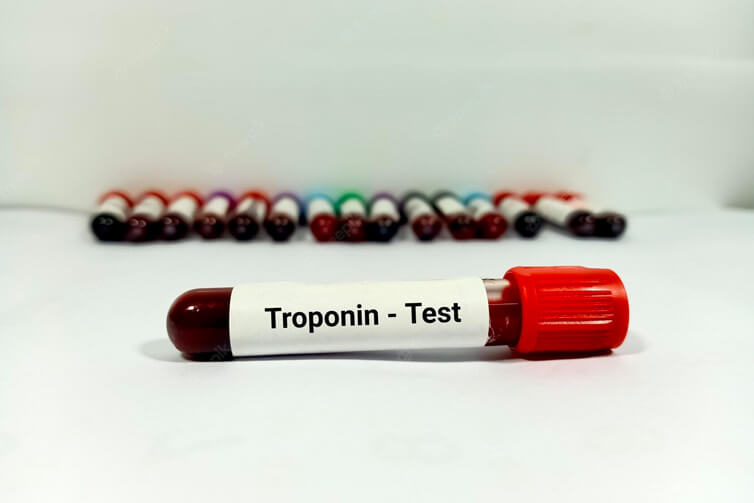
Troponin, a protein specific to skeletal and cardiac muscle fibres, is released from the muscle into the blood due to damage to the heart in unexpected situations such as a heart attack. In relation to cardiac or, in other words, heart-related damage, the troponin value starts to increase in the blood level. The troponin level, which can be detected by a laboratory test performed in the first 1 hour after the damage, reaches its maximum level in the 24th hour and maintains its positive value for 1 week. This structure, which consists of 3 different proteins, troponin C (TnC), troponin I (TnI) and troponin T (TnT), enables the heart to contract by stimulating proteins called actin and myosin. Troponin I and troponin T are differentiated from TnC as cardiac-specific troponins or, in other words, troponins found only in the heart muscle fibre. These protein structures, which are not normally present in the blood, only enter the bloodstream due to cardiac injury. Depending on the extent of the damage, the level of troponins in the blood also increases. The blood taken from the person who applies to the hospital with chest pain is analysed in the laboratory. The increase in the level of these troponins in the blood helps to understand whether the patient has had a heart attack or whether a different condition that causes heart damage has occurred. Therefore, one of the first tests performed on a person who presents to hospital with chest pain or suspicion of a heart attack is the measurement of troponin levels in the blood. Another important feature of the blood troponin level is that troponins that enter the blood in cases of heart damage remain positive for a long time. Before answering the frequently asked questions of what is troponin T or what does low troponin I mean, it is necessary to understand what troponin is.
What is troponin?
Although the shortest answer to the question of what troponin means is a test to find out whether a person has cardiac ischaemia or, in other words, a heart attack, this definition is not enough to explain what troponin is. Although three different proteins called troponin C (TnC), troponin I (TnI) and troponin T (TnT) are classified as troponins of cardiac origin, only TnI and TnT are cardiac-specific proteins. These proteins also combine with tropomyosin to form the stem structure of striated cardiac muscle. At the same time, these three troponins stimulate proteins called actin and myosin. Depending on this stimulation, the contractile movement of the heart takes place. Troponin, one of the heart muscle-specific proteins, enters the blood when the heart muscle is damaged or if the person has a heart attack. The fact that troponin, which is not normally present in the blood, is mixed into the blood is an indication of direct or indirect damage to the heart. Therefore, it is one of the first tests performed on people who present to the hospital with heart attack symptoms. Unlike troponin C (TnC), troponin I (TnI) and troponin T (TnT) are proteins found only in the heart muscle fibres. Although the purpose of measurement of both troponin types is the same, since the sensitivity of the troponin T protein is higher, the TnT value is usually measured at the blood level. Although the frequently asked question of what is troponin I is answered as a protein specific to the heart muscle, it has lower sensitivity than troponin T. In other words, it takes approximately 2 to 6 hours for the troponin I protein to enter the blood as a result of a heart attack or different damage to the heart. It continues to be present in the blood for an average of 1 week. Troponin T, on the other hand, is released into the blood more quickly due to cardiac damage. Troponin T, which is mixed into the blood from the heart muscle in the first 1 hour, reaches its maximum level in the 24th hour after the damage. As with Troponin I, it continues to be seen in the blood for 1 week. The abbreviations cTnI and cTnT, which are frequently seen in troponin tests, are the abbreviations of cardiac troponin I and cardiac troponin T definitions. This is because these two protein structures are only found in cardiac muscles.
Who is the troponin test performed on?
The test, which is performed to determine whether the blood taken from the patient contains troponin in the laboratory environment, is usually requested from people who are suspected of having a heart attack. The test is also performed to assess whether a person presenting to hospital with complaints suggestive of a heart attack, such as chest pain, is suffering from a heart attack or heart damage. Troponin I or troponin T proteins are preferred because they are not normally present in the blood and only enter the blood in case of damage to the heart muscle. Since Troponin T appears in the blood in a shorter time than Troponin I, the cTnT level is often checked in the blood of a person presenting to a health centre with a suspected heart attack. The question of what is cardiac troponin, which physicians frequently encounter, can be answered in this way. If the cTnT level is negative when the patient arrives at the emergency department, the test is repeated 6 to 12 hours later to rule out a suspected heart attack. The troponin test can also be repeated if angina, or in other words chest pain, does not go away despite rest or treatment. The reason for this is that in some cases, chest pain that does not go away is a sign of an imminent heart attack or a risk of a serious heart problem.
Why is troponin elevated?
Although elevated troponin level is important for the diagnosis of heart attack, it is not sufficient alone. In addition to the examination of the troponin level, the combination of physical examination, clinical history and ECG is extremely important for the diagnosis of heart attack. The reason for this is that in some people who have a heart attack, the troponin level does not increase or there is no obvious damage to the heart although the troponin level is elevated. There are two different types of elevated troponin levels in the blood: cardiac and non-cardiac. Cardiac or, in other words, heart-related causes include.
Heart attack defined as myocardial infarction
Acute or chronic heart failure
Tachycardia
Acute inflammatory myocarditis
Aortic dissection
Aortic valve disease
Hypertrophic cardiomyopathy (HCMP)
Apical balloon syndrome, also known as broken heart syndrome
Bradyarrhythmia
Even if it is proved by physical examination, clinical history, ECG and troponin that there is no cardiac problem, an increase in troponin level may be observed in some cases. This condition, which is defined as non-cardiac causes, is mostly associated with renal failure. In addition, myocarditis, known as inflammation of the heart muscle, congestive heart failure and some infections can also cause an increase in troponin levels. Non-acute cardiac disease, cardiotoxicity due to chronic drug use, stroke, COPD, sepsis and excessive exercise may also cause an increase in troponin levels. However, all these conditions, which are defined as non-cardiac, affect the heart muscle for different reasons and cause troponins to be mixed into the blood. This is the reason why troponins found only in the heart muscle are mixed into the blood as a result of these diseases. Some intensive care patients with high or low blood pressure may also have elevated troponins in cases where the heart is overloaded.
Do not neglect to have regular health screenings for your heart health.